
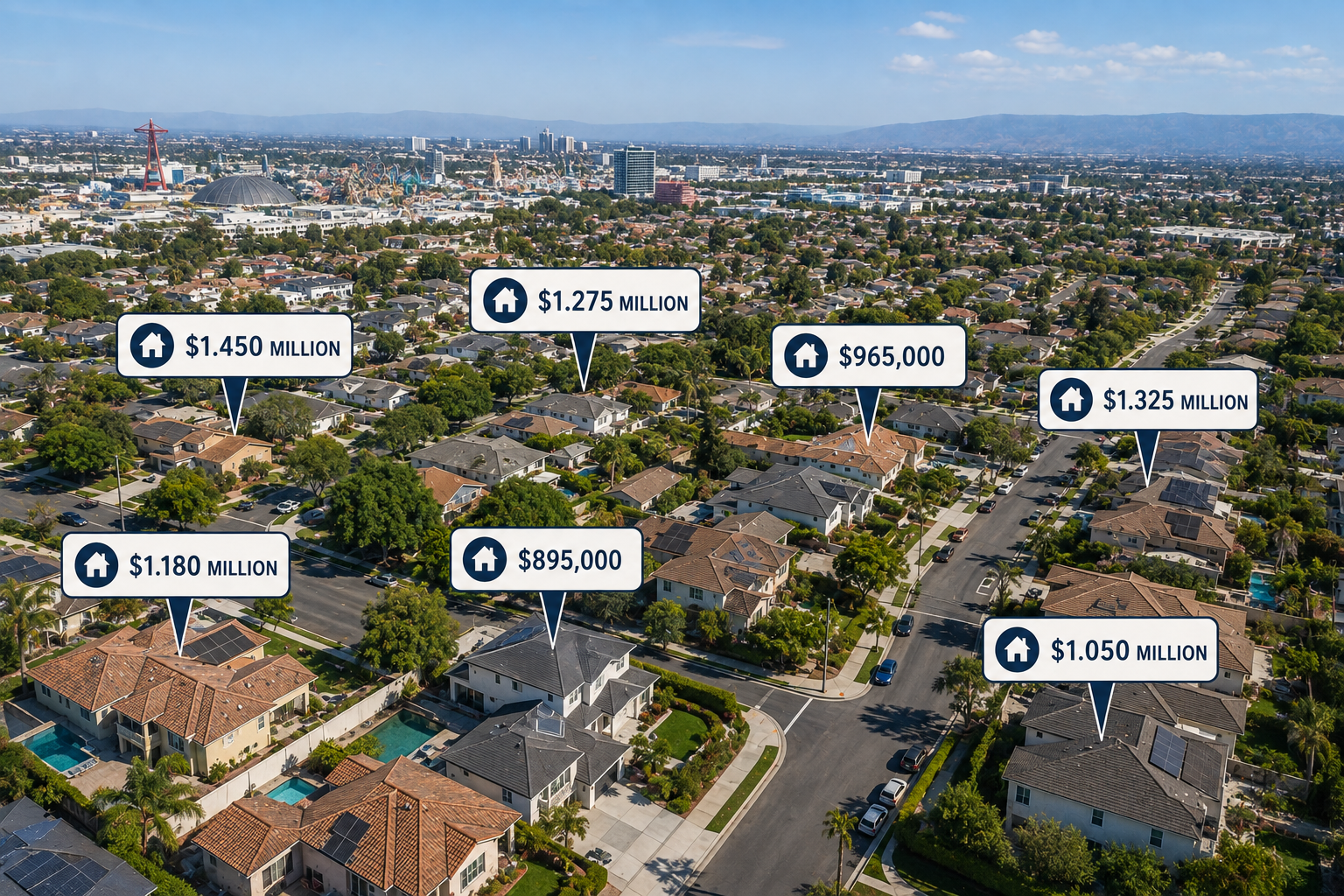
If you’ve looked up your Anaheim home online lately, you may already have a few different answers.
One website gives you one estimate. Another gives you something higher or lower. Then you remember what a neighbor sold for and start wondering which number you should actually believe.
The truth is, your home doesn’t have one exact value sitting in a database somewhere. It has a range of prices buyers would reasonably be willing to pay in today’s market.
Figuring out that range means looking beyond an online estimate. I want to know what similar homes have actually sold for, what buyers would be comparing your home against today, and where your property fits between those homes.
That’s where I would start if you asked me, “Leo, how much is my Anaheim home worth?”
The House Down the Street Doesn’t Automatically Determine Your Value
Recent closed sales are usually the first place I’d look because they tell us what buyers have actually been willing to pay.
But here’s where homeowners can get tripped up.
Let’s say a house two streets over recently sold for $850,000. It’s tempting to think, “My house is about the same size, so mine must be worth $850,000 too.”
Maybe.
But I’d want to look closer.
Was their kitchen remodeled while yours is original? Do you have the larger lot? Did they have an extra bathroom? Does one home back to a busy street while the other sits on a quiet interior location? How did the overall condition compare?
Even the layout can make a difference. Two homes might have almost identical square footage on paper while feeling completely different when you walk through them.
That’s why the closest sale isn’t necessarily the best comparable.
I’m looking for the homes that the same buyer would realistically have considered instead of yours.
That’s a much more useful way to think about comparable sales.
Sold Homes Tell Us What Happened. We Also Need to Know What Buyers Can Choose Today.
Closed sales give us evidence of what buyers have paid, but real estate doesn’t stand still.
Suppose a similar Anaheim home sold three months ago and we think it’s a strong comparable. That’s useful.
Now suppose there are four similar homes for sale today.
Those homes matter too because they’re your competition.
A buyer considering your house isn’t choosing between your home and something that sold three months ago. They’re choosing between your home and the properties they can actually go see this weekend.
This is why I look at active and pending listings along with closed sales.
If buyers have several good options at similar prices, they’re going to compare them carefully. If inventory is limited and your home shows well, you may be in a stronger position.
The sold properties help us understand value. The current competition helps us understand the market you’re entering.
Then I Need to See Your House
This is one of the biggest limitations of an automated home-value estimate.
It hasn’t walked through your house.
It doesn’t experience the home the way a buyer does.
Maybe you’ve remodeled the kitchen, replaced the roof, opened up part of the floor plan, or created a backyard people are going to love.
Or maybe the house is mostly original.
Neither situation automatically tells me what the home is worth. I need to compare your condition against the homes buyers have recently been choosing.
And not every improvement adds back what it cost.
A $40,000 renovation doesn’t automatically make a house worth $40,000 more. What matters is how buyers in that particular market respond to the improvement and what they’re willing to pay for homes with similar features.
This is also why I usually wouldn’t recommend spending a bunch of money preparing a house for sale before we look at the numbers.
I’d rather see the house first, compare it with the competition, and then decide what is actually worth doing.
Anaheim Isn’t One Single Housing Market
This matters more than people sometimes realize.
A citywide Anaheim average can be useful for understanding the general market, but it doesn’t necessarily tell us what a specific house is worth.
Buyers make decisions at a much more local level.
Street location, traffic, lot size, neighborhood characteristics, nearby amenities, school boundaries, condition, and the types of homes immediately surrounding the property can all influence how buyers respond.
Even two homes that appear similar on paper can compete differently once buyers actually see the locations.
That’s why I don’t want to take an Anaheim-wide number and apply it blindly to your house.
I want to narrow the comparison until we’re looking at the properties your likely buyer would actually consider.
Why I Wouldn’t Price Your Home Using Price Per Square Foot
Price per square foot is useful. I look at it too.
I just wouldn’t use it by itself to determine what your home is worth.
Here’s why.
Imagine two homes in the same general area. One is smaller, completely remodeled, has a great layout, and sits on a desirable lot. The other is considerably larger but needs updating and has a layout buyers don’t like as much.
The smaller house could easily command a higher price per square foot.
That doesn’t mean we can take its price per square foot, multiply it by the larger home’s square footage, and suddenly know what the larger property is worth.
Homes aren’t sold by the square foot the way flooring is.
Price per square foot is another piece of evidence. It’s not the valuation method.
So How Accurate Are Zillow, Redfin, and Other Online Home Estimates?
I think online home-value estimates are useful.
They’re just a starting point.
These tools can process an enormous amount of property and market information very quickly. What they can’t completely replicate is someone looking at your particular property and understanding how buyers are likely to compare it with the alternatives.
An automated estimate doesn’t walk through your kitchen.
It doesn’t stand in your backyard.
It doesn’t experience your floor plan.
And it doesn’t have a conversation with you about what’s been changed since you bought the house.
So if Zillow, Redfin, or another website gives you a number, I wouldn’t ignore it. I’d simply treat it as one data point.
Then I’d compare that number against what the local market is actually telling us.
Your Home’s Market Value and Your Listing Price Aren’t the Same Thing
This distinction is important.
Market value is the range we believe buyers are reasonably likely to pay based on the evidence we have.
The listing price is a strategy.
Once I have a good idea of where your home fits in the market, then we can talk about how to position it.
And I don’t automatically believe that listing at the highest possible price is the best way to get the highest possible sale price.
If buyers think a home is overpriced compared with everything else they’re seeing, they may simply move on. On the other hand, I don’t believe every seller should automatically price below market hoping for a bidding war either.
The right strategy depends on the house, the competition, current buyer activity, and your goals.
That’s a conversation I’d have after we understand the home’s probable value, not before.
So, How Much Is Your Anaheim Home Actually Worth?
If you gave me your address today, I wouldn’t immediately give you a number.
I’d start by finding the homes buyers would realistically compare yours against.
I’d look at recent closed sales.
I’d look at what you’re competing against right now.
Then I’d want to see your property so I could understand the condition, layout, lot, upgrades, location, and anything else that might make buyers view it differently from those comparable homes.
From there, I can give you a realistic value range and explain how I arrived at it.
More importantly, you’ll be able to see the same evidence I’m looking at instead of simply being handed a number and being asked to trust it.
If you’re thinking about selling your Anaheim home, or you’re simply curious what it could realistically sell for in today’s market, I can put that comparison together for you.
We’ll look at the numbers, talk through where your home fits, and then you can decide what you want to do next.
Want to know what your Anaheim home could realistically sell for?
See What Your Anaheim Home Could Sell ForGet a local value review based on real comparable sales and current competition.