
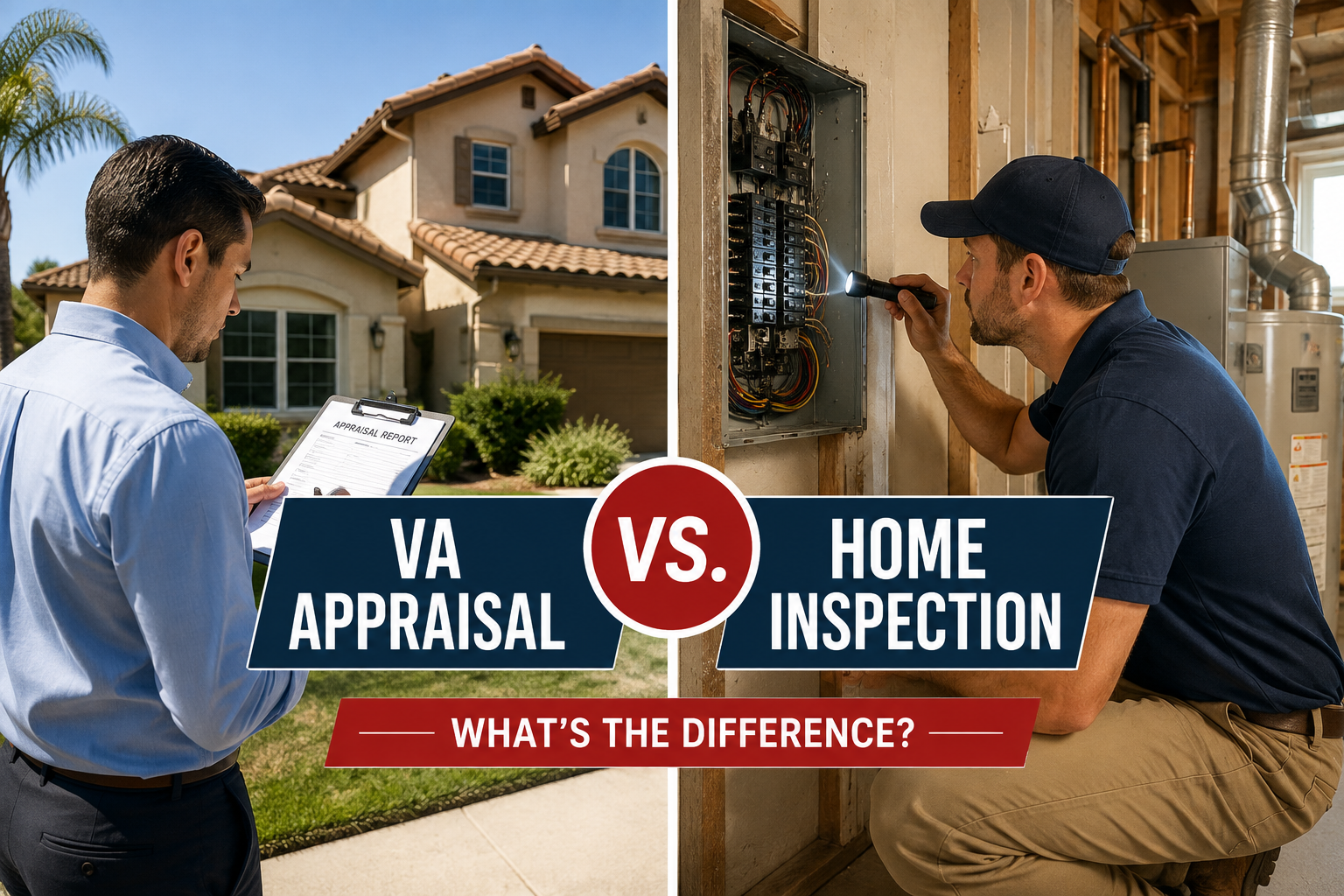
If you’re buying a home with a VA loan, you’ll probably hear two terms early in the process: VA appraisal and home inspection.
They are not the same thing.
A VA appraisal determines the home’s value and evaluates whether the property meets applicable VA Minimum Property Requirements (MPRs). A home inspection gives you a much more detailed look at the home’s condition, systems, and potential repairs or maintenance.
The U.S. Department of Veterans Affairs specifically states that a VA appraisal is not the same as a home inspection and recommends that buyers get a home inspection before purchasing.
If you’re using your VA home loan benefit, understanding the difference can help you avoid surprises and make better decisions before closing.
VA Appraisal vs. Home Inspection at a Glance
| What to Know | VA Appraisal | Home Inspection |
|---|---|---|
| Main Purpose | Determine the home’s value and review applicable VA Minimum Property Requirements. | Evaluate the home’s overall condition and identify potential repairs or maintenance. |
| Required for a VA Loan? | ✓ Yes | ✕ No — but strongly recommended. |
| Who Orders It? | The lender. | The buyer. |
| Determines Home Value? | ✓ Yes | ✕ No |
| Detailed Systems Inspection? | ✕ No | ✓ Yes |
| What It Looks For | Market value and readily apparent conditions related to VA property requirements. | Roof, plumbing, electrical, HVAC, structure, moisture, appliances and other accessible components. |
| Can It Affect Closing? | ✓ Yes. Value or required VA property repairs can affect financing. | Potentially. Findings can affect the buyer’s negotiations and decisions under the purchase contract. |
| Does It Replace the Other? | ✕ No | ✕ No |
What Does a VA Appraisal Look For?
A VA appraisal has two important purposes.
First, the appraiser provides an opinion of the property’s market value. Your lender needs to know that the home supports the value associated with the VA loan.
Second, the appraiser evaluates the property for applicable VA Minimum Property Requirements, commonly called MPRs.
These requirements are intended to help ensure that properties financed with VA loans meet basic standards related to safety, structural soundness, and sanitation.
That doesn’t mean a VA-financed home has to be perfect.
Normal wear, cosmetic issues, or an older component don’t automatically make a home ineligible for VA financing. The appraisal also isn’t intended to provide the detailed examination you would get from a professional home inspection.
That distinction is important because buyers sometimes hear that a home “passed the VA appraisal” and assume that means the property has been thoroughly inspected.
It hasn’t.
What Does a Home Inspector Look For?
A home inspection helps you understand what you’re buying.
An inspector typically takes a much closer look at the accessible systems and components of the property, which may include:
- Roof and attic
- Foundation and structure
- Electrical systems
- Plumbing
- Heating and cooling systems
- Water heater
- Windows and doors
- Drainage and moisture concerns
- Appliances and other accessible components
The inspector isn’t determining the home’s market value.
Instead, the inspection can identify current defects, deferred maintenance, and components that may need attention in the future.
For example, an HVAC system might be functioning today but nearing the end of its expected life. A roof may not leak but could have limited remaining life. An inspector may also notice moisture, plumbing concerns, or electrical conditions that deserve further evaluation.
Those issues may never become VA appraisal conditions, but they could become your expenses after closing.
Does a VA Appraisal Replace a Home Inspection?
No.
This is probably the most important takeaway from this article.
The VA appraisal should not be treated as your home inspection.
The Department of Veterans Affairs tells buyers directly that an appraisal is not the same as an inspection.
A simple way to remember the difference is:
The VA appraisal asks: What is the property worth, and does it meet applicable VA property requirements?
The home inspection asks: What condition is this home actually in, and what might I need to repair, replace or maintain?
As a buyer, you want answers to both questions.
What Are VA Minimum Property Requirements?
VA Minimum Property Requirements are standards used when evaluating properties securing VA-guaranteed loans.
You’ll often hear agents and lenders refer to these simply as MPRs.
The purpose isn’t to make sure you’re buying a brand-new or flawless house. Older homes can absolutely be financed with VA loans.
Instead, VA property requirements address certain conditions involving areas such as safety, sanitation, and structural soundness.
If an appraiser identifies an applicable property condition that needs to be corrected, the appraisal may be made subject to completion of that work.
Your lender and VA appraisal report will ultimately determine what needs to happen for your particular transaction.
This is also one reason it’s helpful to work with a real estate agent and lender who are familiar with VA purchases. Not every defect discovered at a property is automatically a VA repair requirement.
What Happens if the VA Appraisal Finds a Problem?
Don’t panic.
An appraisal condition doesn’t automatically mean the transaction is dead.
The first thing I want to know is exactly what the appraiser identified and what is required to clear it.
If the appraisal identifies an applicable VA property requirement that needs correction, the required work generally needs to be resolved according to VA and lender requirements before the loan can move forward.
Depending on the issue, additional documentation or a follow-up inspection may also be necessary.
This is where your real estate agent and lender need to communicate.
We want to determine:
Is this actually a VA-required repair?
What exactly needs to be corrected?
Who is going to complete it?
Does the appraiser need to verify completion?
How does this affect our contractual deadlines and closing date?
Don’t automatically assume that every appraisal issue can simply be handled with a seller credit and repaired after closing. If the appraisal requires a condition to be corrected, your lender will tell you what is necessary to clear that requirement.
What Happens if the Home Inspection Finds Problems?
Here’s something first-time buyers sometimes aren’t expecting:
Your home inspector is probably going to find something.
That’s normal.
Even well-maintained homes usually have items worth noting.
When I’m reviewing an inspection with a buyer, I prefer to separate the findings into three general categories.
Safety or Significant Defects
These are the things we pay the most attention to.
Examples could include active leaks, significant electrical concerns, structural conditions, or other defects that deserve immediate attention or additional evaluation.
Larger Upcoming Expenses
These aren’t necessarily emergencies, but they’re things you need to know about before buying.
An aging roof, older HVAC system, or water heater nearing the end of its useful life could potentially mean thousands of dollars in future expenses.
Knowing about those items before closing allows you to evaluate them and, when appropriate under your contract, negotiate with the seller.
Normal Maintenance and Cosmetic Items
Then there’s normal homeownership.
Caulking. Paint. Minor wear. A loose handle. A cracked tile.
Those things still belong in the inspection report, but they don’t necessarily deserve the same attention as a significant plumbing, electrical, roof, or structural issue.
The goal isn’t to make a seller deliver a perfect house.
It’s to understand the house you’re buying and make an informed decision.
A Real VA Purchase Example
I recently helped a VA buyer purchase a home here in Southern California, and the transaction is a great example of why the appraisal and inspection serve different purposes.
The VA appraisal came back at value.
That was great news. We didn’t have an appraisal-value issue standing in the way of the financing.
But that didn’t mean our due diligence was finished.
The buyer’s inspections gave us considerably more information about the property’s actual condition. We identified concerns involving plumbing and the crawlspace/foundation area, along with termite work that needed attention.
Now we had information we could actually use.
Instead of assuming that a successful VA appraisal meant the house was problem-free, we evaluated the inspection findings, determined which issues mattered most, and used that information as part of our negotiations.
By the time we finished, we had negotiated:
$13,900 in seller concessions
$4,000 below the original list price
Section 1 termite clearance completed by the seller
Additional agreed-upon repairs addressed
That’s why I don’t want my VA buyers thinking of the appraisal as their inspection.
The appraisal did its job.
The inspection gave us the information we needed to do ours.
Is a Home Inspection Required for a VA Loan?
No.
A traditional home inspection is not required by VA, but the Department of Veterans Affairs strongly recommends that buyers obtain one.
I recommend one too.
You’re potentially spending hundreds of thousands of dollars on a property. An inspection allows you to better understand what you’re buying while you still have the contractual protections available to you.
I’d much rather have a buyer learn about an aging roof or plumbing problem before closing than after they receive the keys.
What if the VA Appraisal Comes in Low?
This is another reason the VA appraisal is different from the inspection.
An inspection isn’t there to determine market value.
The appraisal is.
If the VA appraised value comes in below the purchase price, you and your team need to evaluate the available options.
Depending on the circumstances, those may include negotiating with the seller, evaluating whether a Reconsideration of Value (ROV) is appropriate, or discussing other available options with your lender.
A low appraisal doesn’t necessarily mean the purchase is over, but it’s something your agent and lender should address quickly.
Who Pays for the VA Appraisal and Home Inspection?
The lender orders the VA appraisal through the VA appraisal process, while the home inspection is independently selected and ordered by the buyer.
These are separate services with separate purposes.
Your lender can explain the appraisal fee and how it will appear in your transaction, while your real estate agent can help you coordinate the inspection period and understand your contractual deadlines.
Should You Get Both?
For most VA buyers, my answer is simple:
Yes.
The appraisal and inspection aren’t competing services. They’re giving you different information.
The VA appraisal helps establish value and evaluates applicable VA property requirements.
The home inspection gives you a deeper understanding of the property’s condition and potential expenses.
One doesn’t eliminate the need for the other.
The Bottom Line for VA Buyers
A VA appraisal and a home inspection serve two very different purposes.
Your VA appraisal helps establish the property’s value and evaluates whether the property meets applicable VA Minimum Property Requirements.
Your home inspection helps you understand what you’re actually buying.
And that’s especially important when you’re making one of the largest financial decisions of your life.
If you’re buying a home with a VA loan in Orange County or Southern California, I can help you navigate the process from the initial home search through inspections, appraisal, negotiations, and closing.
You don’t need to know all the VA rules before you start.
That’s what your team is there for.